
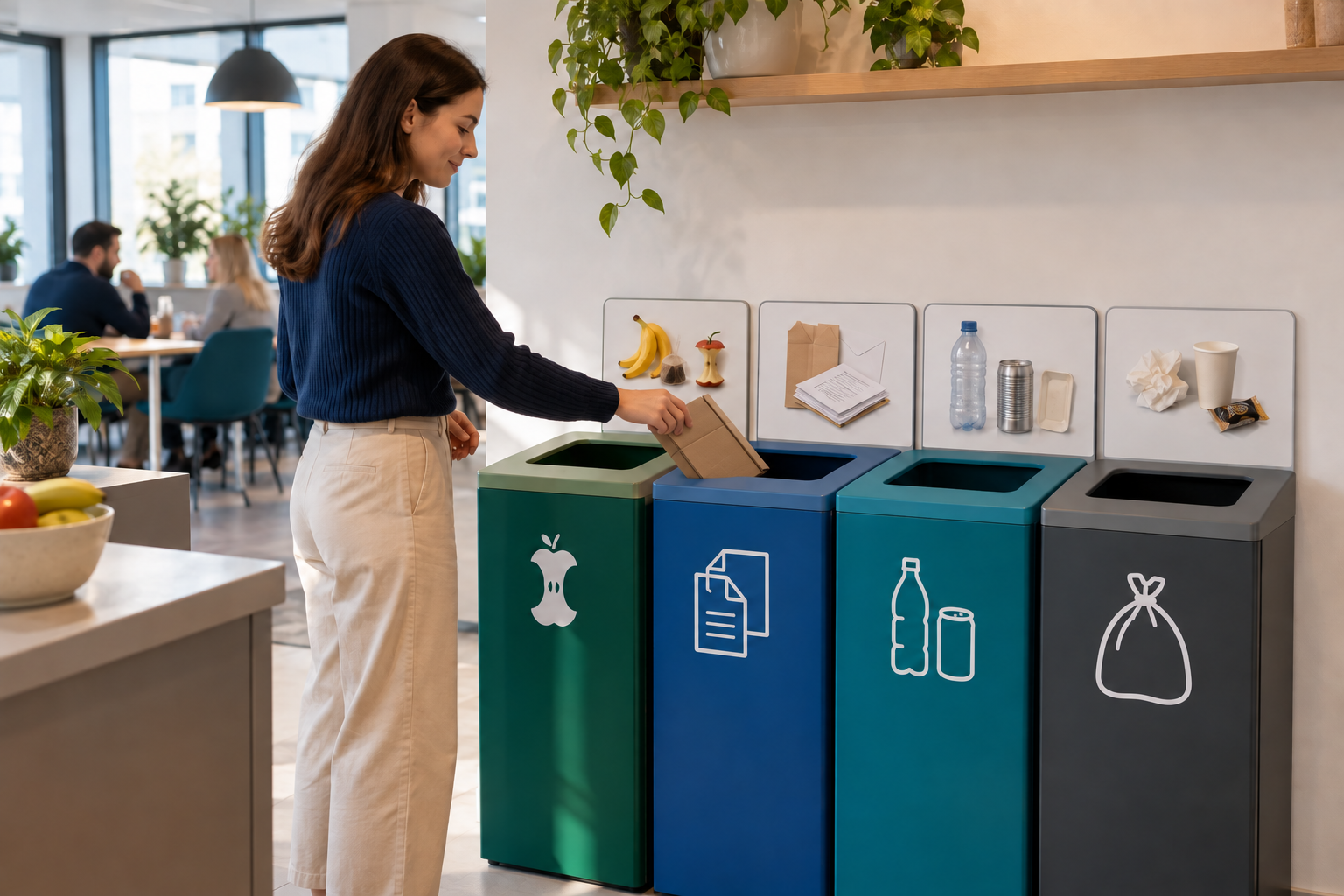
Simpler Recycling is easy to describe and surprisingly easy to fail on detail. This is a check you can run in an afternoon, site by site.
The checklist
- Confirm which nation each site is in. This guidance applies to workplaces in England.
- Count full time equivalent employees across the whole business, not per site. Fewer than ten means the microfirm deadline of 31 March 2027 applies; otherwise the requirements already apply.
- Check that food waste is collected separately at every site, including offices that assume they produce too little to matter.
- Check dry recyclables are collected separately from residual waste, and that paper and card are separate from other dry recyclables unless your collector has completed and retained an applicable written assessment supporting co-collection.
- Read that written assessment if one exists. Sites often believe they have one because a contractor said co-collection was acceptable.
- Check the cleaning regime. Correctly segregated bins are routinely combined into one sack at the end of a shift.
- Check third party and vendor contracts, including catering concessions and contractors on site, so their waste follows the same arrangement.
Source: GOV.UK, Simpler Recycling: workplace recycling in England
The paper and card point
The requirement to keep paper and card separate from other dry recyclables is the provision most often missed, partly because many contracts were written around a single mixed recycling container. Co-collection is possible where a written assessment supports it, but the assessment has to exist and has to be specific to the arrangement in place.
The assessment is completed and retained by the collector, so being unable to lay hands on a copy does not by itself put your site in breach. What it does mean is that you cannot evidence the arrangement. Ask your collector to confirm in writing that an applicable written assessment exists for your service, on what grounds co-collection is justified, and to give you access to it or other evidence you can keep on file.
Source: GOV.UK, Simpler Recycling: workplace recycling in England
Plastic film
Plastic film comes later than the other streams. The government's published timetable introduces plastic film collections from businesses and relevant non-domestic premises in England by 31 March 2027, alongside household collections. Check with your collector how accepted film formats and your service will change, because the date does not mean every type of film will be universally accepted.
The practical point does not depend on the date. Clean stretch film at goods-in is one of the more straightforward streams to separate, because it arises in quantity at a small number of predictable points. A site that already strips wrap into a dedicated container has very little to do when the requirement lands. A site that does not can start on operational grounds alone.
The failure modes are operational, not legal
Non compliance at workplace level is rarely a decision. The likely failure modes are physical: a cleaner with one trolley, a bin store with no space for a fourth container, a night shift with no briefing, or a concession that never joined the arrangement.
Which means the fix is operational too: enough containers, in the right places, with a cleaning regime and a contract that match the segregation you have designed.