
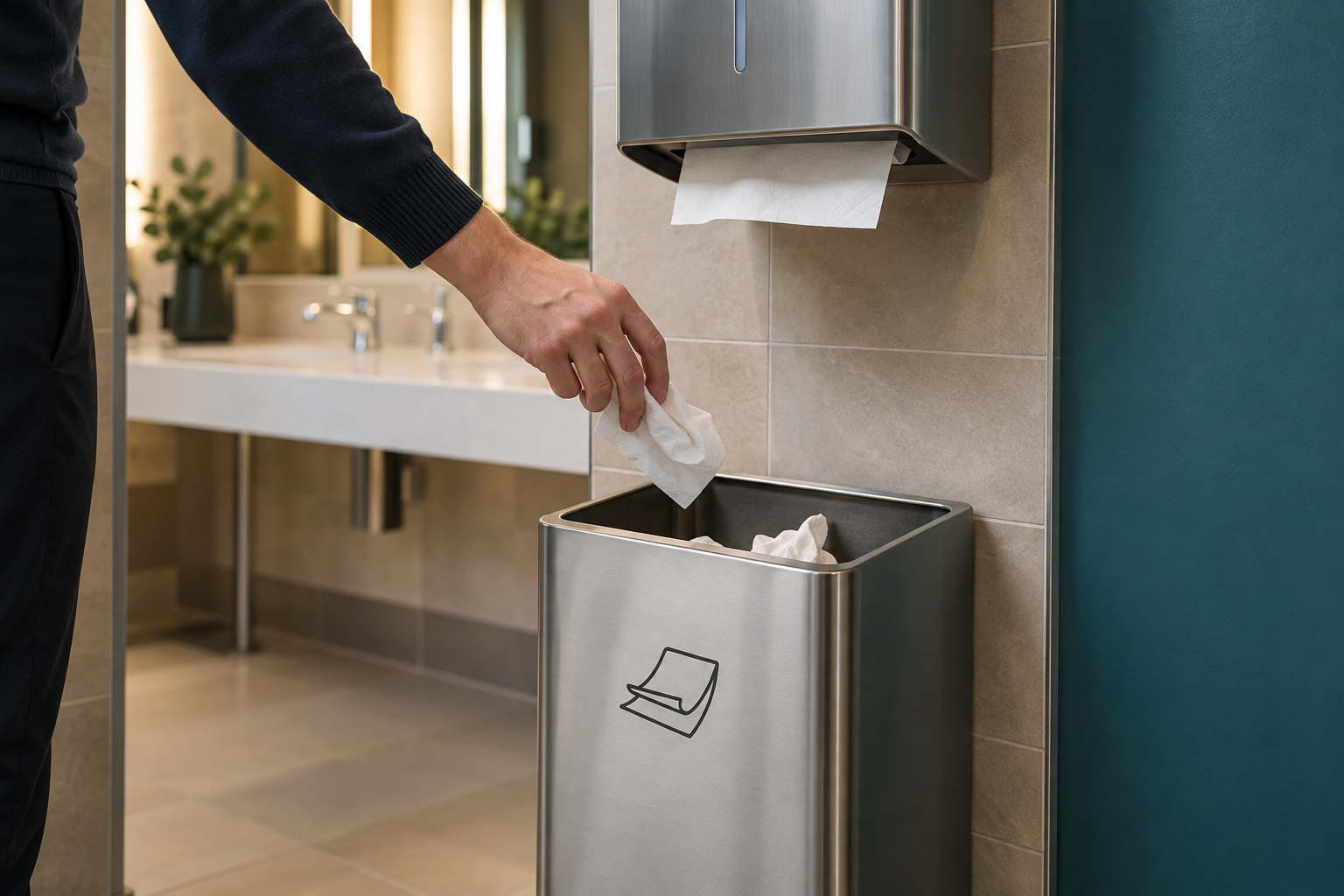
Washroom hand towels are one of the larger single material streams in an office building, and one of the least considered. They are also the stream where good intentions most often produce a rejected load.
Why they are not just paper
Hand towels are manufactured to stay intact when wet, which usually means wet strength additives. Fibre length varies between products and depends on what the towel was made from, so do not assume that every hand towel is already made from recycled fibre or that every product behaves the same way in a reprocessing plant. By the time a towel is discarded it is also damp. Each of those characteristics affects whether a reprocessor can use the material and at what value.
That is why a towel stream is an arrangement with a specific outlet rather than a category. The question is never whether paper towels are recyclable in principle. It is whether the facility receiving your material accepts them, in what condition, and in what quantity.
Acceptance criteria to confirm before you start
- Which towel products are accepted, including any restriction on colour, coatings or additives.
- Maximum acceptable moisture and how the material should be presented, for example in a dedicated liner or loose in a rigid container.
- Whether the outlet takes the material directly or through an intermediate handler, and the minimum volume that makes a collection viable.
- Specific exclusions, which typically include food, cleaning chemicals, gloves, sanitary items and any clinical material.
- What happens to a contaminated load, who inspects it and how you are told.
The washroom is the hard part
A hand towel bin sits in a room where people also dispose of food packaging, coffee cups, sanitary waste and occasionally the contents of their pockets. Unlike a warehouse segregation point, nobody is supervising it and the users change constantly.
Three things tend to determine whether the stream stays clean: the bin is the only obvious receptacle next to the dispenser, there is a separate general waste bin positioned before it on the way out, and the cleaning team understands that the two must not be combined. The third is the easiest link to break, and it is a contract and briefing issue rather than a design one.
Where towels should not go
Two boundaries are absolute. Clinical waste and anything requiring specialist handling must follow its own compliant route regardless of what the towel arrangement allows. And a hand towel stream should not be presented as a general paper stream, because introducing towels into mixed paper can affect the quality of both.
Whoever holds duty of care responsibility for the waste remains responsible for describing it accurately and for checking that the carrier and destination are authorised. That does not transfer to a supplier because a service was purchased.
Is it worth doing?
That depends on the outlet, the volume and the distance, and it has to be worked out site by site. Where a building has high footfall and a viable outlet within a sensible haul, the case is often reasonable: towels are a predictable, repeatable volume that would otherwise sit in residual waste, and the segregation is simple once the outlet is agreed.
For a small site with a long haul to the only accepting facility, the honest answer may be no, and the better move is to reduce consumption at the dispenser. Both conclusions are defensible. What is not defensible is adding a bin and assuming the material is being recycled because it looks as though it should be.