
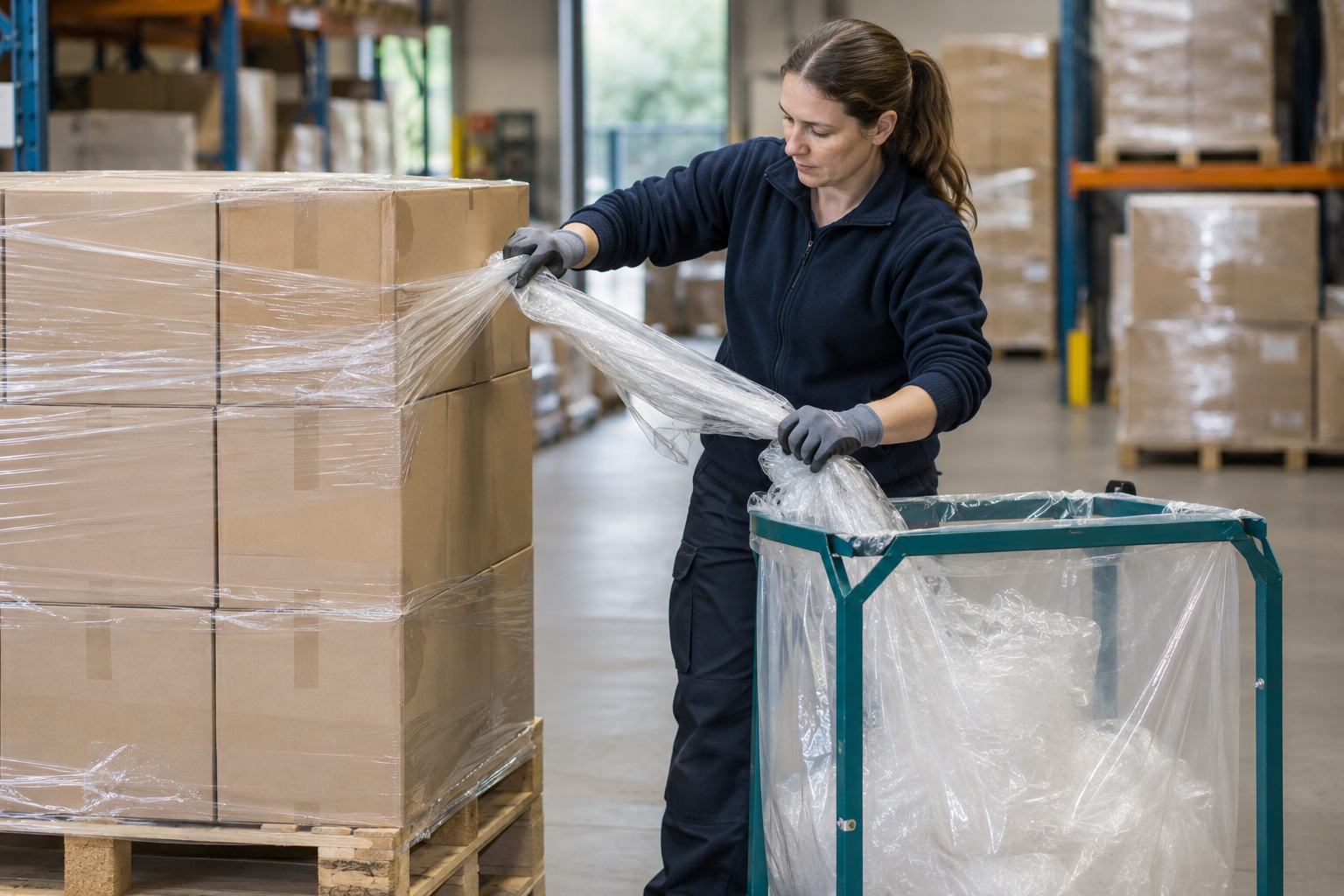
In most distribution operations, stretch film is the material with the largest gap between what it could be worth and what it usually achieves. It arrives in quantity, in a consistent form, at a small number of predictable points. That is close to ideal conditions for recovery.
What goes wrong is almost always mixing.
What the buyer is actually buying
A reprocessor taking stretch film is buying a polymer with known properties, in a known colour, at a known cleanliness. Clear LDPE and LLDPE pallet wrap, free of tape, labels, paper and product residue, is a recognisable commodity.
Introduce coloured film, printed shrink hoods, laminated pouches, bubble wrap with paper backing or bags containing product residue, and you have not created a slightly worse version of the same material. You have created a mixed film that a specific buyer either accepts at a much lower value or refuses outright.
The realistic segregation hierarchy
- Clear stretch film, clean and dry, kept entirely separate. This is the material worth protecting.
- Coloured or printed film kept separate again, since it has its own, generally lower, market.
- Shrink hoods and heavier films, which may or may not be accepted alongside stretch film depending on the buyer.
- Anything laminated, metallised, paper backed or contaminated, which should be treated as residual unless a specific outlet has confirmed otherwise.
Baling, compaction and safety
Densifying film improves transport economics considerably, because loose film is mostly air. That is an argument for baling where a site has suitable, properly maintained equipment and trained operators, with the correct guarding and safe systems of work.
It is not an argument for putting film through equipment that was not specified for it. Film behaves differently from cardboard in a baler, and the wrong machine or the wrong bale configuration creates both a safety risk and bales a buyer will reject. If in doubt, the sequence is to confirm the buyer's required bale specification first and then establish whether your equipment can produce it safely.
Why rebates are not a promise
Film is a traded commodity. Its value moves with polymer prices, reprocessing capacity and demand for recycled content, and the price a specific site achieves depends on quality, consistency, the volume available per collection and the distance to the buyer.
A site producing two bales a month a long way from the nearest reprocessor may find the transport cost exceeds the material value. The usual answer there is to consolidate with other sites. Nor should you assume a separate film stream always carries a carbon benefit: over a long haul with small, poorly densified loads, the transport burden can offset a material part of the gain, so treat the environmental case as something to check rather than something to assert. Any supplier offering a guaranteed rebate irrespective of those variables is making a commercial promise rather than a material one, and it is worth asking exactly what happens when the market moves.
What good looks like on site
Wrap is stripped at a defined point, usually goods-in or the de-kitting area, into a dedicated container that holds clear film only. Remove tape and labels where the receiving specification requires it, and keep them out of the accepted clear film stream. The container is in the operator's path, not five metres away. And someone checks the first few bales against the buyer's specification before a routine is established.
None of that is complicated. All of it degrades quietly if nobody owns it.