
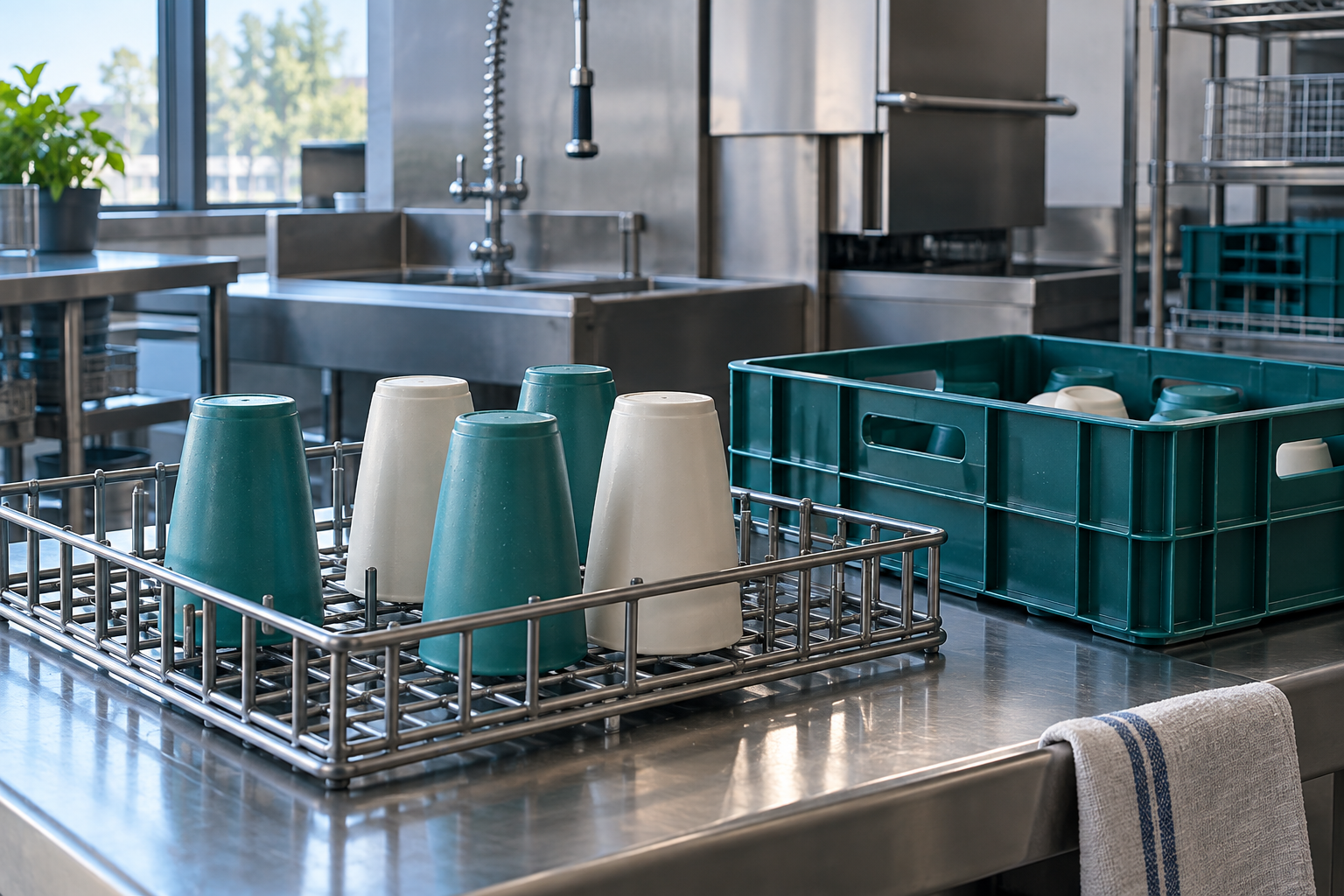
Reuse is intuitively appealing and operationally demanding. The appeal is obvious: one object serving where many would have been consumed. The demand comes from everything that has to happen between uses, none of which is visible when a reusable cup is held up at a launch event.
The honest version of the lifecycle argument
A durable option can have a higher initial production impact than a single use equivalent, so the products being compared need checking rather than assuming. Where that higher initial burden exists, it is repaid across the item's working life, which makes the environmental case depend on achieving enough uses.
A United Nations Environment Programme life cycle review of beverage cups examined exactly this and found that outcomes depend on the number of uses achieved, the washing method and its energy and water use, the material, and transport within the system. It does not produce a single number that applies everywhere, and anyone quoting one should be asked which scenario it came from.
Source: UNEP, single-use beverage cups and their alternatives: life cycle review; UNEP, how to reduce the impacts of single-use plastic products
Four things to design before choosing the object
- Return. Where, exactly, does a user hand the item back, and what makes them bother? Deposit, convenience and staffed collection points all work; hope does not.
- Wash. Who washes, to what standard, with what throughput at peak, and does the site have the water, drainage and space? At a venue this is usually the binding constraint.
- Reissue. How do clean items get back to the point of service in time for the next event or the next shift?
- Losses. What proportion leaves the system each cycle through breakage, theft or souvenirs, and what does replacing them cost?
Why losses decide it
Reuse business cases commonly assume a use count and hold it constant. In practice the use count is the outcome of the return rate, and the return rate is a behavioural number that varies enormously between a staffed stadium concourse and an open air festival.
A modest change in losses per cycle has a much larger effect on both cost and environmental performance than the choice between two similar materials. Which is why the first modelling question should be what happens if the return rate is ten points lower than hoped, not which polymer to choose.
When the operating conditions need another answer
Some settings make the standard logistics hard: a one off event with no washing facility, a dispersed estate with no obvious return route, or hygiene requirements that rule out on-site washing at the throughput needed. The absence of on-site washing does not by itself make single use the better answer. Offsite wash and return services, pooled systems shared between venues or tenants, and a central wash hub serving several sites are all worth pricing before the idea is dropped.
Where none of those can be made to work, a well designed single use item with a functioning capture and recycling route may be the better outcome, and saying so is more useful than installing a reuse scheme that quietly fails.
The honest test is not whether an item can be reused. It is whether your system will actually reuse it, at the rate your case assumes.
Durability, cleanability and actual use
Three product properties do most of the work. Durability decides how many cycles an item survives before breakage takes it out of the pool, and the failure point is often a lid, a seal or a thread rather than the body. Cleanability decides how quickly and reliably an item can be returned to service: narrow necks, blind recesses and textured surfaces slow a wash line down and raise the risk of an item going back out unfit.
Actual use decides everything else. An item people are happy to carry, and happy to hand back, accumulates cycles. An item that is heavy, awkward or unpleasant to drink from stays in a cupboard or leaves the pool. These are ordinary product design questions, but they only pay off inside a system that recovers, cleans and reissues the item, so product design and system design need doing together.
It is also worth separating two different things. A personal bottle someone buys and keeps is not a pooled return and wash scheme, and evidence from one tells you very little about the other. The design principles overlap; the logistics do not.