
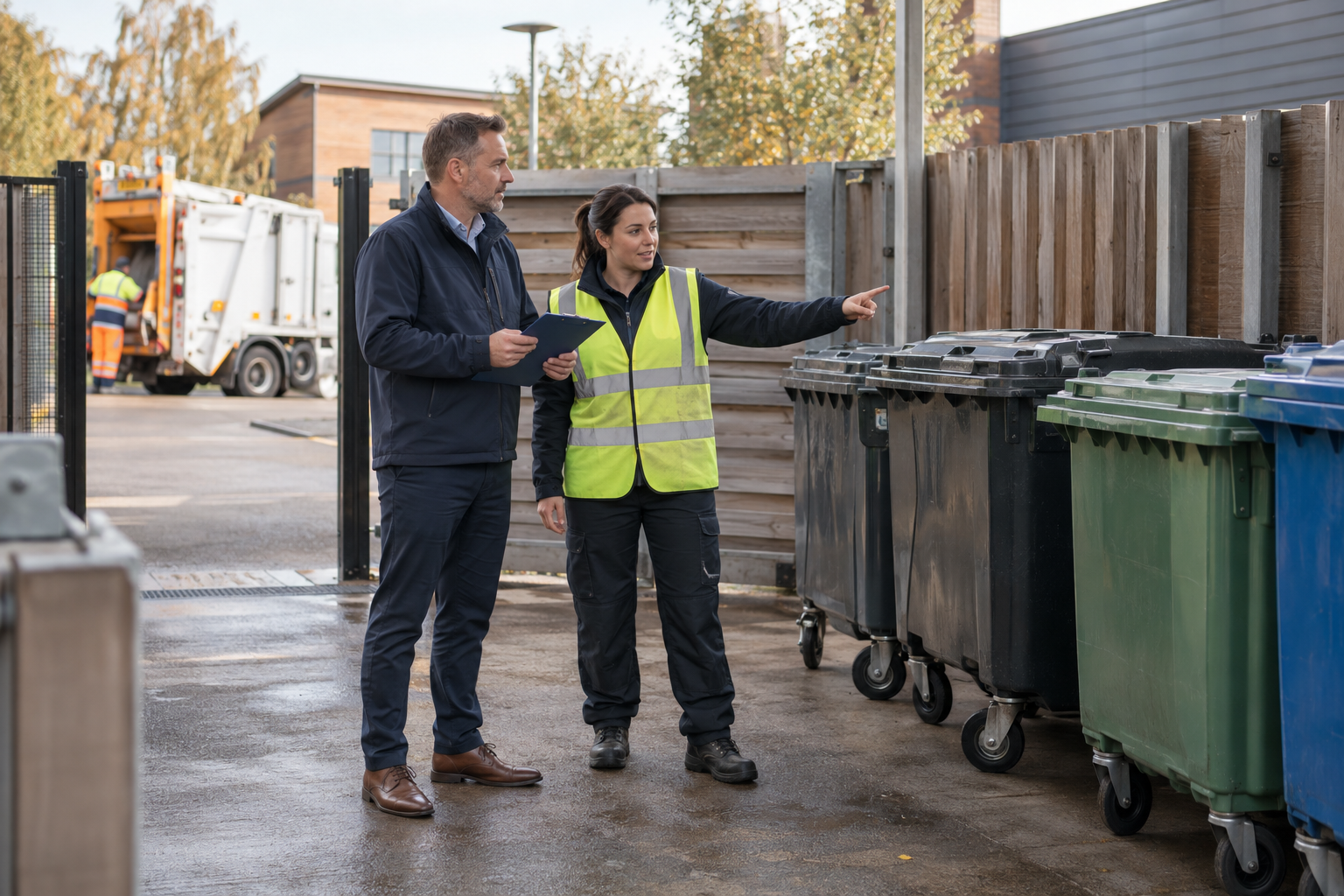
Waste services are unusually easy to buy badly. The unit being priced looks simple, the rate card invites a direct comparison, and the true cost only appears once the service is running.
Write the brief around the material, not the containers
The most consequential decision in a waste tender is made before any supplier sees it: what material you expect to arise, in what volume, at what points, and what you want to happen to it. A brief that simply reproduces the existing container schedule will procure the existing service at a marginally better rate, and will carry forward every inefficiency in it.
Start with the material arising and the outcome you want for each stream. Let the container and frequency schedule follow from that, and let suppliers propose an alternative schedule if they can justify it.
Frequency is where the money is
Collections are typically charged per lift regardless of how full the container is, so a schedule that does not match the material arising is paid for anyway. Take a purely hypothetical illustration: a container lifted weekly at 10 pounds a lift costs 520 pounds over 52 weeks. If the same container could safely and permissibly be lifted fortnightly, the same 26 lifts would cost 260 pounds, a theoretical difference of 260 pounds before any constraint is applied.
That figure is arithmetic, not a saving. Hygiene requirements, seasonal peaks, storage capacity in the bin store and the risk of overflowing containers can all make the lower frequency unworkable, and a reduced schedule sometimes brings additional costs of its own. Use the calculation to identify where to look, then test it against how the site actually operates. Ask how frequency is reviewed, how quickly it can be changed, whether there is a charge for changing it, and whether the supplier will report fill levels. A slightly higher rate with a responsive schedule can be the better contract.
Ask for the full charge list
- Contamination and non-conforming load charges, including how a load is assessed and what evidence you receive.
- Failed or aborted collection charges, including access issues and containers not presented.
- Excess weight charges and the weight threshold applied.
- Container delivery, exchange, repair and removal charges.
- Ad hoc and out of hours collection rates.
- Rebate mechanisms for recovered material, including how the price is set and who bears a market fall.
- Annual indexation and fuel or disposal cost pass through mechanisms.
Duty of care does not transfer
Buying a service does not move legal responsibility for your waste. Government guidance for England and Wales is clear that a business must describe its waste accurately, check that whoever takes it is authorised to do so, and keep records. Arrangements differ across the UK nations, so confirm the position for each site rather than applying one description everywhere.
Practically, that means the tender should ask for carrier, broker and dealer registrations, permit details for receiving sites and a description of the documentation you will receive, and your own team should retain the records rather than relying on the supplier's portal alone.
Accountability and mobilisation
Mobilisation is where a well priced contract quietly comes apart. Containers arrive late, the site team is never briefed, the bin store layout was never surveyed and cleaners keep combining streams. None of that is a pricing issue.
Ask for a named account manager with a named deputy, a written mobilisation plan with dates, a site survey before go live, and agreed service levels with a review meeting scheduled in the contract rather than offered informally. Then hold the first review even if nothing has gone wrong, because that is when the small problems are still cheap to fix.
How to compare bids honestly
Model each bid against a realistic year: your expected tonnage and lifts, plus a plausible number of contamination events, container exchanges and ad hoc collections. Compare those totals, not the headline rates. The ranking changes more often than people expect.